Desire Paths: Choice & Resistance, or How to Observe a Place in Time
*The following text is part of an urban study of a twelve-hectare stretch of IOR Park in Bucharest, illegally retroceded in 2005 and progressively destroyed since, examining how desire paths reveal long-term patterns of community use and spatial memory.
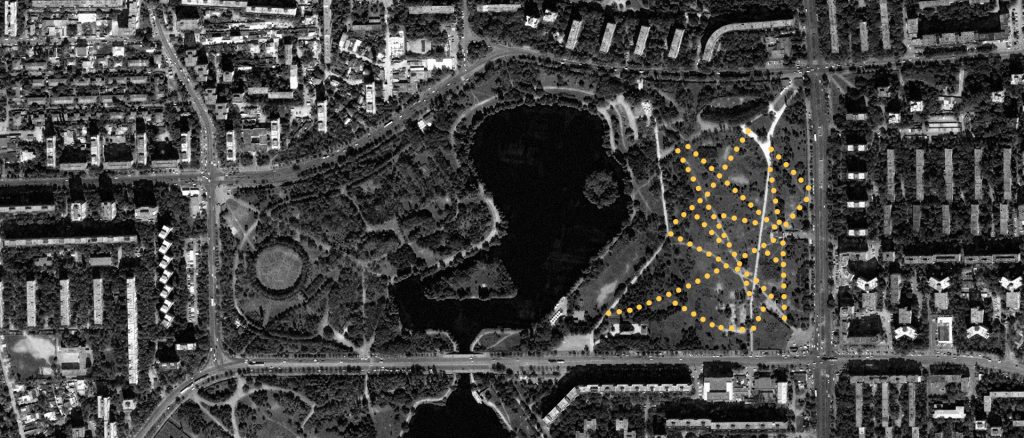
The paths (yellow dots) that exist today have been shaped and used by people since the park’s earliest days.
Desire paths, or instinctive paths, those narrow, improvised trails worn into the ground by countless footsteps, are less an accident than a quiet consensus. Formed over time by people choosing, again and again, to walk the same way, they offer a collective method of listening to a place, of observing it without formal instruction. They are, at once, physical traces and living archives of communal habit. In the twelve-hectare area of IOR Park that was illegally retroceded, these paths are not simply shortcuts. They are durable evidence of how the land has been used, and continues to be used, by those who pass through it.
Their story begins in the 1970s, alongside the development of the Titan neighborhood and the park itself. As the area took shape, so did the movements within it. People crossed open ground according to need, inclination, and convenience; the paths appeared gradually, not by design but by repetition. They emerged in quiet defiance of the area’s initial, somewhat rigid layout, structured around a single main alley that still persists, and extended it with routes that reflected a more fluid, human rhythm.
In the early 1980s, the opening of the Titan subway station intensified this network. With easier access came more purposeful crossings, toward the lake, toward the neighborhood, toward the existing alleys. These routes became habitual. The space itself functioned less as a margin and more as an extension of the park, woven into the routines of daily life.
Urbanists sometimes describe such patterns in terms of reduced friction, the ease with which a space accommodates movement. The paths in the retroceded area illustrate this with unusual clarity. They offer physical ease, by connecting points directly; cognitive ease, by following intuitive lines; and social ease, by virtue of their long-standing, tacit acceptance. Over decades, they have become not incidental but essential, part of the park’s unwritten infrastructure.
The events of 2005, when the land was illegally retroceded, did little to alter this underlying logic. Even as the area suffered what can only be described as an ecocide, people continued to walk where they had always walked. The persistence of these movements reads, in retrospect, as a form of urban resistance. While authorities and the so-called owner have attempted to recast the space as something other than a part of the park, the paths offer a counterargument, one inscribed daily underfoot. They suggest a place that remains alive, used, and, in a quiet sense, reclaimed.
The freedom to choose one’s own route here is not a recent reaction, nor a symbolic gesture. It is the continuation of a relationship that predates the rupture. The paths express a longstanding refusal to submit entirely to imposed frameworks, particularly those that disregard lived experience. They reflect, instead, an attachment to the ways the space has been used, naturally, collectively, and over time.
To speak of desire paths, in urban terms, is to speak of a method of attention. They reveal how people need to move, to connect, to breathe within a landscape. Their logic is not prescriptive but emergent, shaped by use rather than decree. If planning is to be responsive, it must contend with these patterns, not as anomalies to be corrected but as signals to be understood.
People created these paths out of convenience, certainly, but also out of instinct, a preference for directness, for autonomy, for the small assertion of choosing one’s own way. Around them, nature has continued its slower work, adapting and enduring even when disrupted. Today, the paths in the retroceded area may be more visible than ever. They are routes, but also records, of how the space functioned before 2005, when the park was, unequivocally, a shared public right.
Along the paths, despite the ecocide, nature continues to thrive and regrow at its own pace.
There is, too, an intimacy in walking such paths. Even in contested terrain, the act of crossing it creates a bond. To walk is not only to move through a place but, in some sense, to remake it. Each passage reaffirms the park’s presence, reopening it, however modestly, to those who use it. When these paths endure despite damage, they become evidence of a deeper insistence that green spaces should remain accessible, continuous, and free.
They might be understood as a kind of map, one that documents not property lines or official designations, but freedom. They record a community’s refusal to disappear, tracing the real tempo of the place. Where barriers are proposed, they suggest continuity. Where damage occurs, they preserve memory. And where the landscape risks erasure, they begin, quietly, to draw it again.
In the end, the instinctive paths in the retroceded area of IOR Park are not incidental marks on the ground. They are testimonies to an ongoing, collective story, one that persists, step by step, despite interruption. They affirm a set of claims that are at once modest and profound, the right to green space, the right to belong, the freedom to move, and the enduring capacity of a community to write its own geography, even when other narratives attempt to take hold.
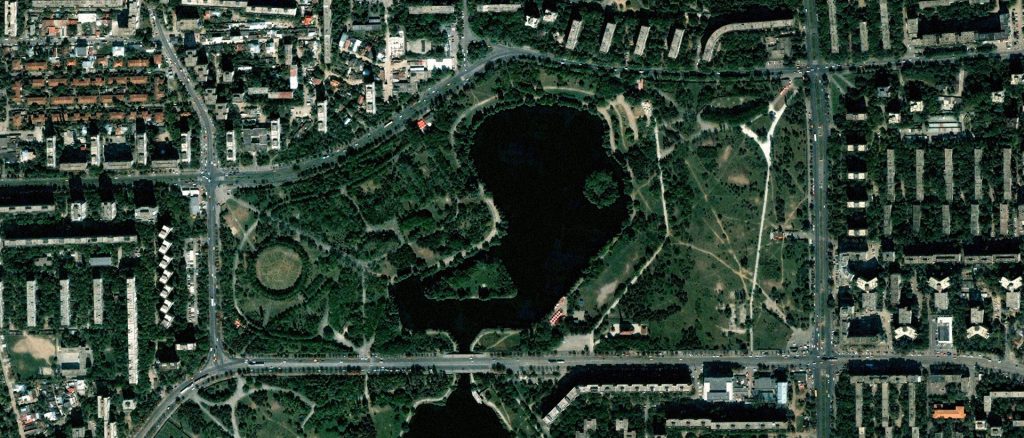
The 12-hectare area in 2000, before the retrocession and the ecocide.
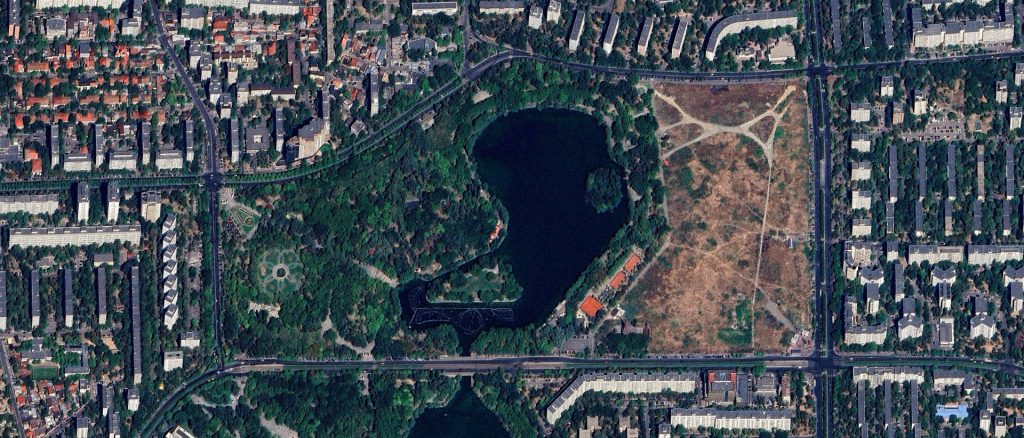
The same 12-hectare area today, after the retrocession and the ongoing ecocide.
*After the land was illegally retroceded in 2005, it was left to decay, the state withdrawing its care. For years, it lay neglected. In 2023, the destruction intensified, with fires, poison, and the cutting of more than 1,500 trees. It continues still, as those responsible methodically cut down whatever manages to grow. Now, the state is considering its expropriation, a move that, for many, comes as yet another bitter turn in a long and troubling history.
Read more about the subject here:
Charred urban roots